Gas Cylinder Safety: Manual Handling and the UK Rules
A full gas cylinder is one of the heaviest and most awkward loads in any workshop. This guide covers what can go wrong when cylinders are moved by hand, what the Manual Handling Operations Regulations 1992 and HSE guidance say, and how to make cylinder changes safer.
The risks of handling cylinders by hand
Strained backs, shoulders and elbows
A full large argon or mixed-gas cylinder can weigh 80 kg or more, and it has no handles. Hugging it up onto a welder puts the whole weight through the body.
Crushed feet and hands
HSE's welding guidance lists crushing and impact injuries among the hazards of handling and transporting cylinders. A cylinder that slips can land on a foot or trap fingers.
Damaged valves and leaks
If a cylinder falls or is knocked over, its valve can be damaged and gas can escape. That puts everyone nearby at risk, not just the person moving it.
What the law says: the Manual Handling Operations Regulations 1992
The regulations set out a clear order of steps for employers. Under regulation 4, each employer must:
- 1Avoid manual handling that involves a risk of injury, so far as is reasonably practicable.
- 2Assess any handling that can't reasonably be avoided, with a suitable and sufficient risk assessment.
- 3Reduce the risk of injury to the lowest level reasonably practicable.
Employers must also give staff information on the weight of each load where it's reasonably practicable, and review the assessment when the work changes significantly. Under regulation 5, employees must make full and proper use of any safe system of work their employer provides.
What HSE's guidance says
There's no legal weight limit. HSE points out that the law doesn't set specific weight limits. Instead, its leaflet Manual handling at work: a brief guide (INDG143) gives guideline weights as a risk filter. The highest is 25 kg for men and 16 kg for women, for a load held close to the body between knuckle and elbow height, and the figures drop for loads held further away, higher up or lower down. HSE stresses that these are not safe limits, and that going beyond them is likely to increase the risk of injury.
A full cylinder is far outside the filter. At 80 kg or more, a large cylinder weighs over three times the highest guideline figure. The filter also assumes a load that's easy to grip with both hands, and a smooth, round cylinder isn't.
Training isn't enough on its own. HSE's leaflet says that information and training alone won't ensure safe manual handling, and it points to mechanical aids and handling aids as ways to reduce the risk. For assessing lifting, lowering and carrying tasks, HSE publishes the Manual handling assessment charts, known as the MAC tool.
Moving cylinders in welding work. HSE's leaflet on gas welding and cutting (INDG297) advises against moving a cylinder by tilting it on its base and rolling it, saying it's better to use a trolley. It also says to turn the gas off at the cylinder before cylinders are moved, and to secure cylinders with a stout chain or strap so they can't fall or be knocked over.
A safer cylinder change
- Turn the gas off at the cylinder valve before you move it.
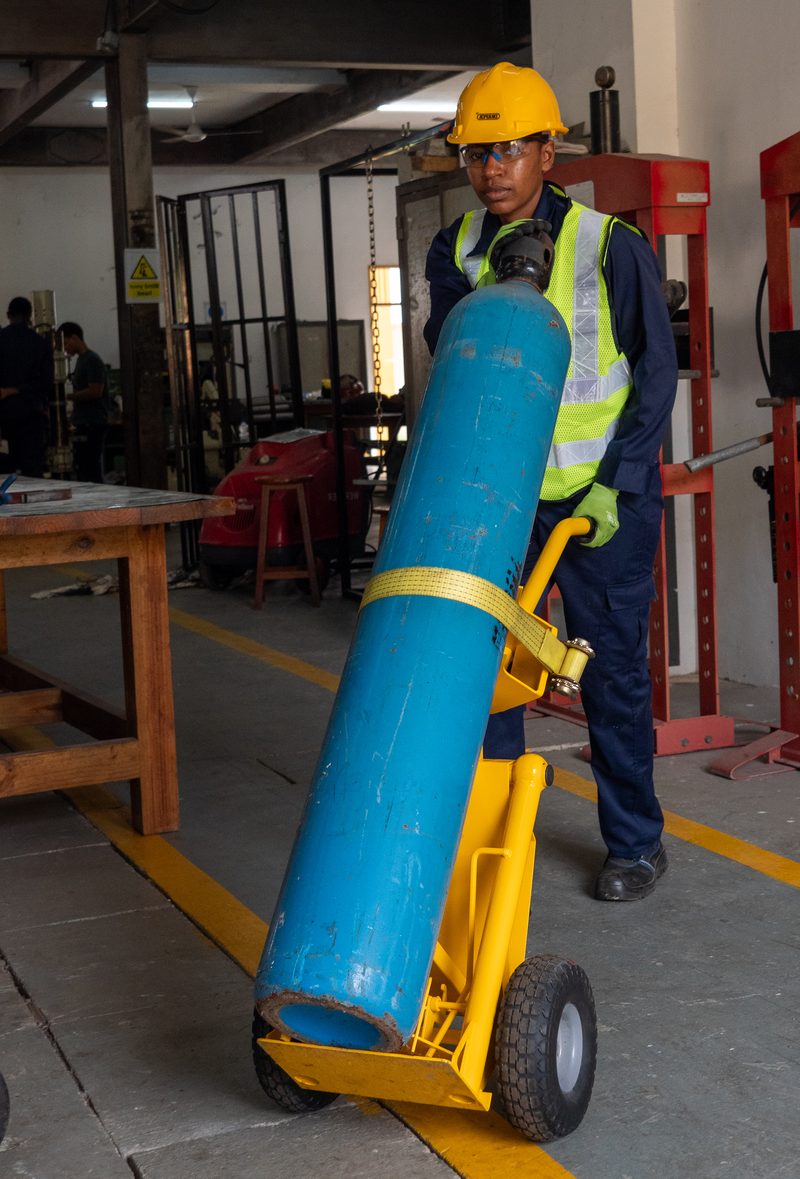
- Don't tilt and roll cylinders across the floor. Use a trolley or handling aid.
- Strap the cylinder securely before it moves.
- Once it's in place, chain or strap it to the welder's cylinder carrier or a wall.
- Wear safety footwear and gloves.
- Include cylinder changes in your manual handling risk assessment, and review it if anything changes.
Where the Cylinder Lifter fits
The Cylinder Lifter is a non-powered trolley designed to take the hand lift out of cylinder changes. The cylinder is held to the frame with a 50 mm ratchet strap, the pivot frame carries the load so only about 14 kg reaches the handle, and the cylinder is set down onto platforms up to 250 mm high. It takes cylinders up to 100 kg and around 254 mm in diameter.
An ergonomic assessment using the MAC tool and the Rapid Entire Body Assessment (REBA) concluded that it significantly reduces the risks of changing cylinders by hand. It is CE and UKCA marked, which is our declaration as the manufacturer that it meets the Supply of Machinery (Safety) Regulations 2008. That isn't an approval from HSE.
Does it count as lifting equipment?
No. The Cylinder Lifter is a manual handling aid, not lifting equipment under the Lifting Operations and Lifting Equipment Regulations 1998 (LOLER), so it doesn't need LOLER thorough examinations. Like any work equipment, it should still be checked regularly to make sure it's in safe working condition.
This page is a plain-English summary, not legal advice. Check the full regulations and HSE guidance that apply to your workplace.
Questions about the Cylinder Lifter?
Our FAQs cover cylinder sizes, lift height, delivery and warranty.
